
Key Takeaways
- Language learning in preschool helps children build confidence in listening, speaking, asking questions, telling stories, and expressing their ideas.
- Children develop these skills gradually through everyday conversations, shared experiences, and interactions with adults and peers.
- Inquiry-based learning encourages children to observe, ask questions, explain their thinking, and respond to different perspectives.
- Multilingual exposure helps children use English and their Mother Tongue in meaningful, everyday contexts.
- The 100 Languages of Children recognises that communication can also happen through drawing, movement, building, dramatic play, and other forms of expression.
- At home, simple habits such as reading together, following your child’s interests, and giving them time to respond can support their confidence in communication.
Introduction
When your child tells you about something that happened at preschool, asks “why?” for the tenth time, or tries to explain an idea to a friend, they are doing much more than practising new words. They are learning how to organise their thoughts, listen to others, and make themselves understood.
This is why language learning in preschool goes beyond memorising a vocabulary list. In these early years, it’s important to help children use language with purpose: to ask, describe, negotiate, imagine, and connect.
Why Your Child’s Early Years Are Crucial for Language Development
The preschool years are when children make noticeable progress in understanding and using language. They begin to put longer sentences together, tell more detailed stories, ask more questions, and explain their thoughts more clearly.
This development occurs gradually. According to the American Speech-Language-Hearing Association (ASHA), children may progress towards speech and language milestones such as:
- Around ages 3–4: Children may start telling simple stories, taking part in longer conversations, and speaking more clearly
- Around ages 4–5: They may begin using more complex sentences, linking ideas together, following longer instructions, and sharing their thoughts in greater detail
Of course, every child develops at their own pace, so parents should use these milestones as general guides rather than fixed deadlines.
Language learning in preschool gives children many chances to practise these skills in everyday situations. During a story, they may predict what happens next. In a small group, they may explain an idea or listen to a friend’s point of view. During an inquiry, they may describe what they notice and ask questions that lead the conversation further.
Over time, these repeated interactions help children become more confident listeners and communicators, while also building the skills they will later use for reading, writing, and learning with others.
How We Encourage Language Learning at E-Bridge Pre-School
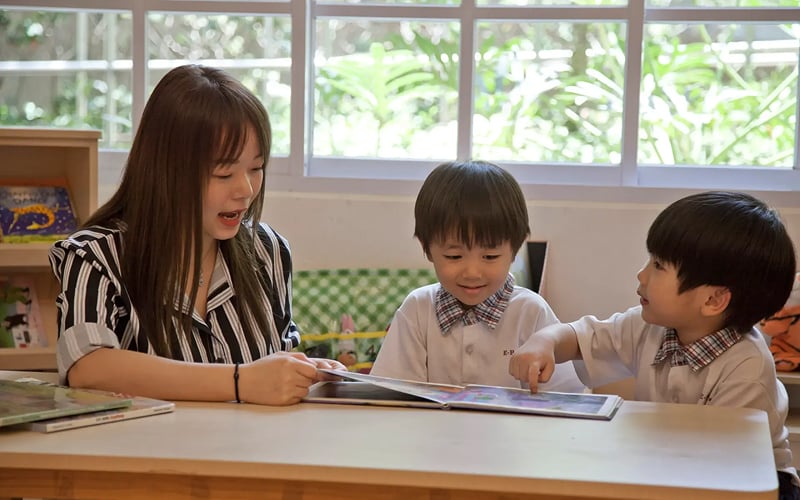
At E-Bridge Pre-School, we see language as something children develop through everyday interactions, not as a skill practised in isolation. Our educators create learning opportunities throughout the day through inquiry, storytelling, projects, routines, and conversations.
1. A Language-Rich Environment Through Inquiry and Dialogue
A child who notices a caterpillar on a leaf might ask, “Where is it going?” Instead of immediately answering, an educator may respond with another question: “What do you think?” A simple exchange like this encourages the child to observe, think, and put their ideas into words.
Through guided inquiry-based learning and open-ended questions, our educators encourage children to:
- Describe what they notice
- Explain their thinking
- Ask questions
- Listen to different ideas
- Build on what others have said
Over time, these everyday conversations help children become more comfortable expressing their ideas, responding to others, and taking part in longer discussions.
2. Learning to Communicate Across Languages
Many children in Singapore grow up hearing and speaking more than one language. At E-Bridge Pre-School, we support this through a multilingual learning environment, with mother-tongue educators helping children engage with different languages throughout the day.
Rather than limiting language learning to dedicated preschool lessons, we weave English and Mother Tongue into stories, conversations, songs, projects, and familiar routines. This encourages children to connect words and expressions with what they see, do, and discuss, allowing them to use different languages with purpose.
We also see multilingual learning as a way for children to encounter different cultural traditions, perspectives, and ways of communicating. Over time, this can help them grow more comfortable expressing themselves across different linguistic and social settings.
3. Supporting Different Ways of Communicating
Children do not always express what they know through words alone. Some may talk through an idea, while others first make sense of it through drawing, building, movement, dramatic play, or other forms of expression.
At E-Bridge Pre-School, we practise the Reggio Emilia concept of the 100 Languages of Children, which recognises the many ways children communicate their thoughts, feelings, and understanding. In a diverse learning environment, our children have access to varied materials and opportunities to explore ideas in ways that feel natural to them.
These different forms of expression can also become starting points for conversation. A drawing may prompt a child to explain what they have created, while a construction project might lead them to describe a plan, solve a problem with a peer, or introduce new words as their thinking develops.
By recognising these different ways of communicating, we give children more opportunities to find their voice and gradually become more confident expressing their ideas to others.
Tips for Encouraging Language Learning at Home
Language learning does not only take place in preschool. The everyday moments you share at home can also give your child valuable opportunities to listen, respond, and express what they are thinking.
- Follow your child’s interests: If they point something out or bring up a topic they enjoy, stay with it and let the conversation unfold naturally.
- Read and talk about stories together: You can pause during storytime to wonder aloud about what a character might be feeling or what could happen next.
- Chat about everyday routines: Cooking, travelling, shopping, or getting ready for bed can create natural opportunities to introduce new words and ideas.
- Give your child time to respond: Giving your child a little extra time to gather their thoughts can help them express themselves more comfortably.
Most importantly, show interest in what your child is trying to say. When children see that their ideas are valued, they gain more confidence in expressing them.
Conclusion
Language learning in preschool is most meaningful when children have regular opportunities to use it in real conversations, whether they are sharing an idea, asking a question, listening to others, or making sense of an experience. These exchanges help children build the confidence and communication skills they will carry into future learning and relationships.
At E-Bridge Pre-School, our Reggio Emilia-inspired, guided inquiry-based approach, multilingual environment, and respect for the many ways children express themselves create space for communication to develop naturally. As part of the Early Childhood Development Agency’s Anchor Operator programme and the EtonHouse International Education Group, we bring together established early childhood practices with an approach that honours each child’s curiosity, individuality, and potential.
If you would like to learn more about how we support your child’s language and communication development, contact us to find out more.