
- Home >
- Curriculum >
- Reggio Emilia >
- The 100 Languages of Children
The 100 Languages of Children
What Are the 100 Languages of Children?
The concept of the 100 languages of children comes from the Reggio Emilia philosophy in Italy. It was inspired by educator Loris Malaguzzi, who used the idea as a powerful metaphor to describe the many ways children think, feel, and express understanding. It suggests that children do not rely on words alone. Instead, they communicate through drawing, building, movement, music, dramatic play, sculpture, storytelling, and countless other forms.
This idea is beautifully captured in The Hundred Languages of Children poem, which reminds us that children are born with rich potential and creativity, even though traditional education sometimes narrows these expressions. The “hundred” is symbolic, representing infinite possibilities rather than a fixed number.
By recognising multiple forms of expression, educators create environments where children can explore ideas deeply and share their thinking in ways that feel authentic and meaningful to them.
How We Nurture this Principle at E-Bridge
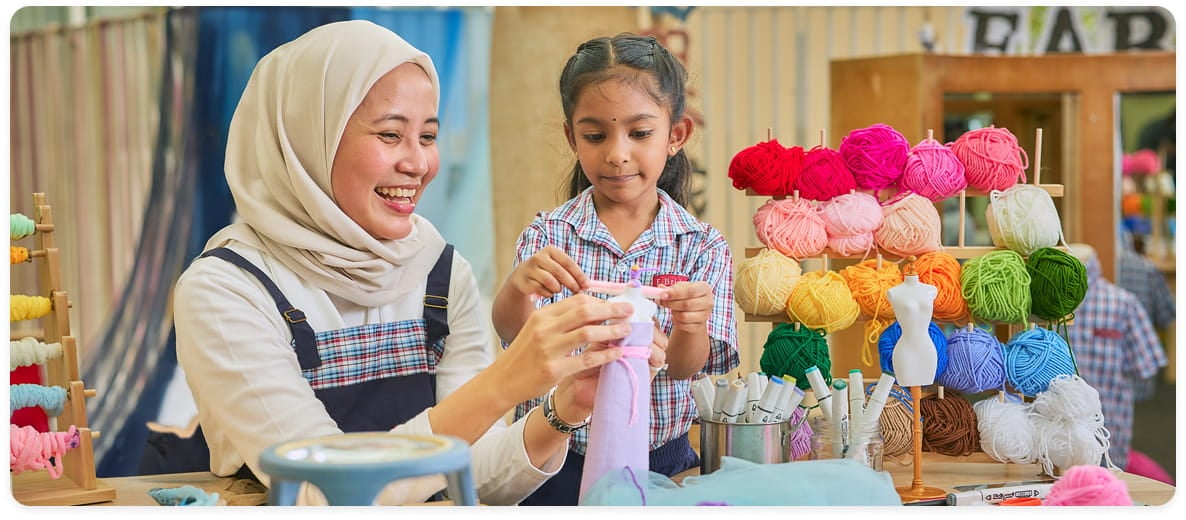
At E-Bridge, the philosophy behind the 100 languages of children is reflected in the way learning experiences are designed. We intentionally provide varied materials, meaningful dialogue, and open-ended opportunities so children can express ideas in ways that feel natural to them.
Language Through Art and Creative Media
Children are given access to drawing tools, paint, clay, collage materials, and other creative media to explore ideas visually. Art is not treated as a decorative activity but as a thinking process. Through colour, texture, and form, children represent their observations and theories, refining their understanding as they create.
Language Through Movement and Dramatic Play
Movement and role play allow children to embody ideas physically. Through dance, gesture, and imaginative scenarios, children explore emotions, relationships, and real-world experiences. Dramatic play strengthens social understanding while giving children another avenue to express thoughts that may be difficult to articulate in words.
Language Through Construction and Design
Blocks, loose parts, and building materials encourage children to translate ideas into three-dimensional forms. As they construct and redesign structures, they experiment with balance, space, and problem-solving. Construction becomes a language through which children test hypotheses and represent their thinking concretely.
Language Through Nature and Exploration
Outdoor experiences and natural materials invite children to observe patterns, textures, and living systems. Through collecting, comparing, and investigating elements from the environment, children develop curiosity and scientific thinking. Nature offers open-ended possibilities for discovery and interpretation.
Language Through Conversation and Collaboration
Dialogue is central to learning. Educators listen attentively and ask thoughtful questions, while children exchange ideas with peers. Through conversation and shared inquiry, children clarify their thinking, consider different perspectives, and build understanding collectively.
Why the 100 Languages Matter in Early Childhood
Recognising the 100 languages of children transforms the way we view early learning. When children are encouraged to express themselves in multiple ways, they are not confined to a single measure of ability. Instead, they are supported as capable thinkers with diverse strengths. This inclusive perspective allows every child to participate meaningfully and develop confidence in how they share ideas.
• Builds confidence
When children see their drawings, constructions, movements, and conversations valued equally, they gain assurance that their ideas matter. This strengthens self-belief and encourages active participation in learning.
• Strengthens communication skills
Exposure to varied forms of expression expands how children communicate. They learn to articulate ideas verbally, visually, and physically, developing clarity and adaptability in different social settings.
• Encourages problem solving
Open-ended exploration invites children to test theories and refine their thinking. By representing ideas in different ways, they approach challenges creatively and learn to consider multiple solutions.
• Supports different learning styles
Each child processes information differently. Offering diverse avenues for expression ensures that learning is accessible, allowing children to engage in ways that align with their natural strengths.
• Develops emotional intelligence
Through conversation, role play, and creative expression, children explore feelings and relationships. This deepens empathy, self-awareness, and the ability to understand others’ perspectives.
Frequently Asked Questions
What does the term “100 languages of children” really mean?
The 100 languages of children is a metaphor from the Reggio Emilia approach. It refers to the many ways children express their thoughts, feelings, and ideas, through drawing, building, movement, music, storytelling, and more. The concept reminds us that communication goes far beyond spoken or written words.
Is this concept only relevant in a Reggio Emilia setting?
While the idea originates from the Reggio Emilia approach, its principles can enrich any early childhood environment. Recognising multiple forms of expression supports inclusive learning and encourages children to explore ideas more deeply across different contexts.
How does this support inquiry-based learning?
When children can represent ideas in different ways, inquiry-based learning becomes more meaningful. They are able to test theories through construction, reflect through drawing, or refine ideas through discussion. Multiple forms of expression allow inquiry to be sustained and thoughtful.
How is this different from traditional child-led learning?
Child-led learning often centres on following children’s interests. The concept of the 100 languages extends this by ensuring children also have varied tools to express those interests. It combines autonomy with intentional support from educators who scaffold thinking and reflection.
Is this approach suitable for a preschool in Singapore?
Yes. In a preschool in Singapore, recognising multiple forms of expression supports bilingual development, social interaction, and creative thinking. It complements local curriculum goals while encouraging deeper engagement and collaboration.
How can parents learn more about this philosophy at E-Bridge?
Families who are curious about how these principles come to life in our classrooms are welcome to contact us for more information. Our educators are happy to share how children’s ideas are nurtured through meaningful exploration and reflective practice.