
Key Takeaways
- Responsive caregiving is the practice of observing your baby’s cues, understanding what they mean, and responding in a timely and appropriate way.
- Simple daily moments, such as feeding, play, and rest, help your baby feel safe and understood.
- Consistent, warm responses build trust and support early emotional security.
- Early interactions shape how your child communicates, connects, and explores their environment.
- A supportive infant care setting reinforces these interactions through attentive care and familiar routines.
Introduction
Your baby may not speak yet, but communication has already begun. Every look, movement, or cry is part of an ongoing interaction that develops between you and your child. You are learning to read these signals, and your baby is learning what to expect from your responses.
Responsive caregiving centres on this shared process of connection, and it is more important than you might think. In this article, we take a closer look at how recognising and responding to these cues supports your baby’s development in the early months.
What is Responsive Caregiving?
Responsive caregiving is a nurturing, relationship-based approach in which caregivers pay close attention to a child’s verbal and non-verbal cues, understand what they may be communicating, and respond in a timely and appropriate way.
Caregivers should:
- Pay attention to the child’s cues (crying, smiling, reaching, turning away)
- Understand what those cues mean (hungry, tired, scared, wants attention)
- Respond quickly, warmly, and consistently
For example, when a child cries, the caregiver might first check whether they are hungry, tired, or need comfort. If the child points at something, the caregiver can name the object and talk about it, helping to build language and communication skills.
Why Does Responsive Caregiving Matter?
Supports Emotional Development
The early months of life play an important role in shaping how children experience and express emotions. When caregivers respond warmly and consistently, babies begin to understand that their needs will be met. This supports emotional development by helping infants feel safe, secure, and better able to regulate their emotions over time.
For instance, soothing a crying baby does more than stop the crying. It helps them learn how to calm down with the support of a trusted caregiver. Over time, these experiences contribute to the development of resilience and emotional awareness, helping children understand that their feelings can be managed.
Building Strong Early Relationships
Responsive caregiving plays an important role in building secure attachment in babies. When a baby receives care that is consistent, predictable, and nurturing, they begin to feel safe and understood.
Over time, this attachment style helps shape how they relate to others. It supports confidence in social settings, encourages clearer communication, and lays the foundation for healthy relationships as they grow.
Can Infant Care Centres Provide Responsive Caregiving?
Many parents choose to enrol their child in infant care, whether for additional support, a structured environment, or to help manage work and daily commitments. You may also wonder whether your baby will continue to receive attentive, responsive care in an infant care setting.
At E-Bridge Pre-School, responsive caregiving is embedded in our infant care programme. Through close observation, consistent routines, and meaningful interactions, our educators support each infant’s wellbeing, learning, and development.
1. Educators Trained in Caregiving Practices
Our educators are trained in responsive caregiving practices. They pay close attention to how each baby communicates by observing cues such as crying, facial expressions, body movements, and eye contact, and responding in ways that are appropriate to each child’s needs.
For example, if a baby becomes fussy during play, our educators may observe whether they are tired or overstimulated and adjust the experience or support them through a transition to rest. If a baby makes sounds or gestures, educators respond with eye contact, conversation, or simple words to encourage communication. Through these everyday interactions, our educators build familiarity and trust with each infant, helping them feel safe, secure, and supported.
2. Low Educator-to-Infant Ratios for Personalised Attention
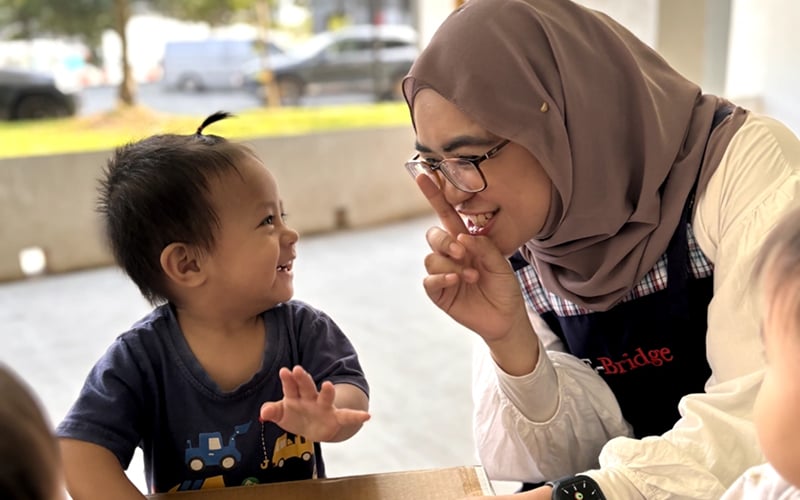
At E-Bridge Pre-School, our smaller group sizes allow educators to spend more time with each baby. With a ratio of 1:3 (three infants to one educator), it is much easier to notice subtle changes in each child’s behaviour and respond without delay. This ensures that care is focused on the individual, rather than spread too thinly across too many children at once.
This closer attention also means educators can adjust their approach based on the child. For example, one baby may settle best with gentle rocking, while another may respond better to soft talking or being given a moment to calm down independently. By adapting how they respond, educators are able to support each child in a way that feels familiar and comfortable to them.
3. Smooth Transitions That Respect Each Child’s Pace
In our infant care programme, educators support infants through daily transitions with care and sensitivity. They adjust their approach based on each child’s cues and readiness, helping transitions feel calm and reassuring.
For example, if a baby is still focused on exploring a toy, the educator may give them a few more moments before gently guiding them to the next experience. If a baby becomes fussy before nap time, the educator may respond by soothing and comforting them to help them settle.
By responding to each infant’s cues in this way, educators help create a calm and reassuring environment where children feel supported throughout the day.
4. Clear Communication with Parents for Continuity of Care
Responsive caregiving extends beyond the infant care setting. At E-Bridge Pre-School, our educators maintain regular communication with parents to support continuity of care between the centre and home. They share updates on each child’s daily experiences, helping parents stay informed about their child’s routines and wellbeing.
This ongoing communication helps parents and educators work together to support each child’s care and development. By maintaining a shared understanding of the child’s daily experiences, children benefit from greater consistency between home and the centre.
Conclusion
Responsive caregiving is built through small, consistent interactions that help your baby feel safe, understood, and supported. By noticing cues, responding appropriately, and maintaining consistent routines, caregivers play an important role in supporting early emotional and social development. Whether at home or in an infant care setting, these everyday moments help build trust, confidence, and a strong foundation for children to explore the world around them.
At E-Bridge Pre-School, responsive caregiving is an integral part of our infant care curriculum. Through close observation, meaningful interactions, and consistent routines, our educators support each infant’s individual needs while creating a caring and nurturing environment where they can learn, grow, and thrive.
To learn more about E-Bridge Pre-School’s infant care programme, contact us today.