
Key Takeaways
- A Reggio Emilia-inspired classroom encourages children to explore, collaborate, and express their ideas in different ways.
- Each learning area serves a distinct purpose, supporting creative expression, sensory exploration, reflection, and problem-solving through meaningful learning experiences.
- Natural materials, open-ended resources, and visible documentation encourage children to investigate ideas and make connections through hands-on exploration.
- Shared learning spaces and small-group experiences foster communication, collaboration, and independent thinking.
Introduction
In the Reggio Emilia approach, the classroom is often described as the “Third Teacher”, recognising the important role the environment plays alongside educators and families in supporting children’s learning. It is based on the belief that the environment can influence how children think, explore, communicate, and interact with the world around them.
Inspired by these principles, a Reggio Emilia-inspired classroom is carefully planned to encourage curiosity, exploration, and active participation. Natural light, open-ended materials, inviting learning spaces, and visible documentation encourage children to ask questions, investigate ideas, and express themselves in meaningful ways.
Key Elements of a Reggio Emilia-Inspired Classroom
Here are some of the key learning areas and features you may find in a Reggio Emilia-inspired preschool in Singapore.
1. The Atelier (Art Studio or Creative Centre)
The atelier is a dedicated creative space where children explore ideas through art, movement, design, and hands-on exploration. Filled with materials such as paints, clay, wire, recycled objects, and natural materials, it supports the Reggio Emilia concept of “The Hundred Languages of Children”—the belief that children express their thoughts, emotions, and understanding of the world in many different ways beyond spoken language.
Rather than guiding children towards identical outcomes, educators encourage open-ended exploration and creative expression. Children are invited to experiment with different materials, represent their ideas in different ways, and refine their thinking as they learn through the creative process.
2. Small-Group Learning Areas
A Reggio Emilia-inspired classroom often includes dedicated spaces where small groups of children can gather for deeper, more focused exploration. In these quieter learning areas, children investigate materials, ideas, or questions together while engaging in meaningful discussions with their peers and educators.
Learning in small groups encourages children to collaborate, observe closely, and remain engaged in an inquiry over time. It also helps them develop the confidence to share their ideas, listen to different perspectives, and work through challenges together.
3. Cosy Reading Nooks and Reflection Areas
Cosy reading nooks and reflection areas provide children with quiet spaces to read, think, and enjoy moments of calm throughout the day. Often furnished with comfortable seating, soft furnishings, and inviting displays of books and learning materials, these spaces encourage children to engage independently while supporting a sense of comfort and belonging.
Beyond nurturing a love for reading, these quiet spaces also encourage children to pause, reflect, and regulate their emotions when they feel overwhelmed or need a moment to reset. By providing opportunities for both quiet reflection and independent exploration, they support children’s emotional well-being and help them return to their learning with confidence.
4. Construction and Building Area
Construction and building areas encourage children to explore creativity, problem-solving, and early engineering concepts through open-ended learning experiences. Using materials such as wooden blocks, recycled items, loose parts, twigs, stones, and other natural materials, children are invited to design, build, test their ideas, and refine their thinking as they learn through exploration.
As children experiment with different materials and approaches, they develop spatial awareness, communication and collaboration skills, persistence, and creative thinking. They also learn to work through challenges, adapt their ideas, and appreciate that there are many ways to solve a problem.
5. Sensory Exploration Stations
Sensory exploration stations encourage children to investigate the world around them using their senses. These learning areas may include sand, water, tactile materials, light tables, or sensory trays that spark curiosity and invite open-ended exploration.
As children compare the textures of different materials, observe how water flows and changes shape, or explore light and shadows, they develop observation skills, problem-solving abilities, and scientific thinking. These meaningful learning experiences also support cognitive
6. The Piazza (Shared Learning Space)
The piazza is a shared learning space inspired by the idea of a town square, where children come together for conversations, collaborative learning experiences, storytelling, and reflection. As a central gathering place, it encourages interaction, cooperation, and a strong sense of community within the preschool environment.
In this shared space, children learn to listen to different perspectives, express their ideas with confidence, and participate actively in group discussions and collaborative inquiry. These everyday interactions help strengthen communication skills, build positive relationships, and foster a sense of belonging.
7. Documentation Panels and Learning Walls
In Reggio Emilia-inspired classrooms, documentation panels and learning walls make children’s thinking and learning visible. Through photographs, children’s creations, recorded conversations, and documentation of ongoing inquiries, educators capture the learning process rather than focusing only on the final outcome.
These displays encourage children to revisit their ideas, reflect on their experiences, and build on previous discoveries. They also provide families with meaningful insight into their child’s thinking, interests, and learning journey, creating stronger connections between home and preschool.
8. Nature and Discovery Table
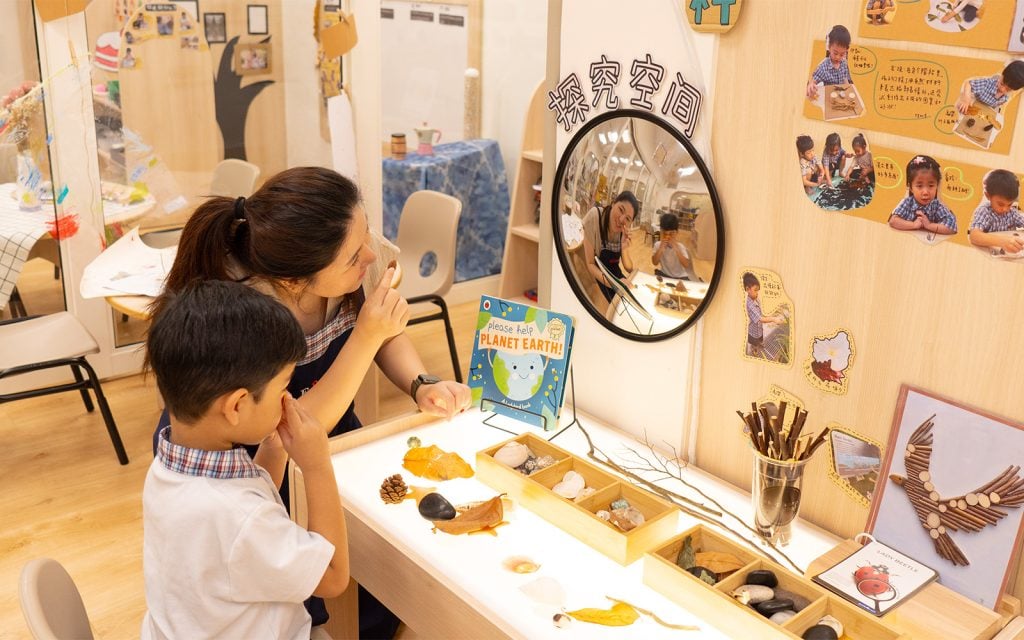
Nature and discovery tables bring elements of the natural world into the learning environment through collections of leaves, shells, stones, pinecones, flowers, and other natural objects. These materials invite children to observe, compare, and investigate the textures, patterns, colours, and characteristics of the world around them.
As children explore how these materials change over time, they develop observation skills, curiosity, and an appreciation for nature. These meaningful learning experiences also encourage children to ask questions, make connections, and deepen their understanding through hands-on exploration.
9. Mirrors and Light Exploration Areas
Mirrors and light exploration areas encourage children to investigate reflection, light, shadows, symmetry, and perspective through hands-on exploration. Using mirrors, light tables, reflective materials, and natural light, children are invited to observe how light interacts with different objects, colours, and surfaces while exploring their own ideas and questions.
Through experimenting and making discoveries, children develop observation skills, scientific thinking, and spatial awareness. These meaningful learning experiences also encourage creativity, curiosity, and imaginative exploration as children investigate the world around them in new and engaging ways.
How Our Learning Environments Support Holistic Development
In our centres, classrooms are inspired by the Reggio Emilia approach and carefully planned to nurture children’s curiosity, creativity, and sense of inquiry. Open and flexible spaces invite children to explore, collaborate with their peers, and express their ideas through meaningful learning experiences.
Our indoor and outdoor learning environments support children’s cognitive, social, emotional, and creative development. Natural materials, open-ended resources, and engaging learning areas provide opportunities for children to investigate questions, solve problems, and make connections through hands-on exploration.
Our preschool educators play an important role in shaping these learning environments. By observing children’s interests, strengths, and emerging ideas, they adapt learning experiences and introduce materials that extend children’s thinking and inquiry. This responsive approach supports children in becoming confident, independent learners who are curious about the world around them.
Contact us to learn more about our Reggio Emilia-inspired, guided inquiry-based curriculum and our programmes.