
Key Takeaways
- Open-ended play materials encourage children to explore, experiment, and express ideas freely without being limited to a single outcome.
- Everyday materials such as blocks, fabrics, recycled items, and natural materials support creativity, imagination, and flexible thinking.
- In Reggio Emilia-inspired learning environments, children develop problem-solving, collaboration, and communication skills through hands-on exploration.
- Educators support learning by observing children closely, asking meaningful questions, and extending their inquiry based on children’s interests and ideas.
- Carefully planned learning environments encourage curiosity, confidence, and creativity by giving children opportunities to direct their own learning.
Introduction
Walk into a Reggio Emilia-inspired preschool, and you may notice something different straight away. Instead of rows of identical toys or activities with predetermined outcomes, you will often find baskets of wooden blocks, fabric pieces, recycled materials, clay, loose parts, and natural materials waiting to be explored.
These carefully selected resources are known as open-ended play materials. They play an important role in supporting children’s curiosity, creativity, and self-expression while encouraging them to explore, investigate, and learn through meaningful learning experiences.
What Are Open-Ended Play Materials?
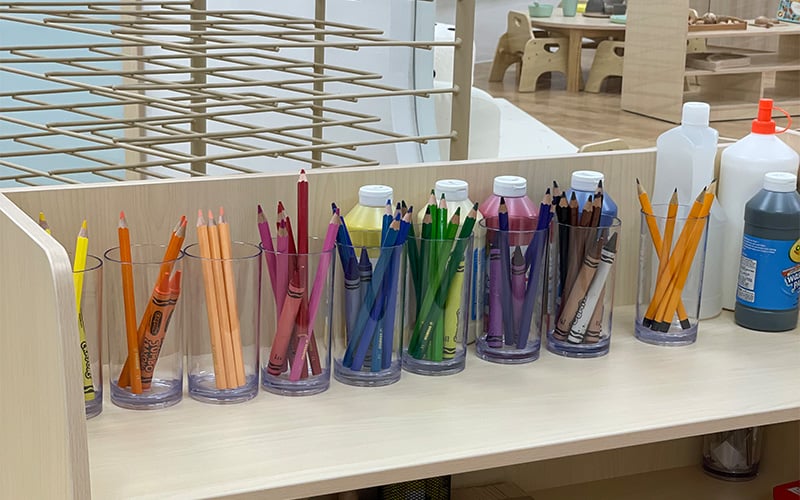
Open-ended play materials are resources that children can use in many different ways, without a single “correct” outcome or intended blueprint. Common examples include wooden blocks, fabric pieces, river stones, pre-loved keys, loose parts, recycled materials, and a variety of art materials.
Unlike toys with fixed features or predetermined functions, open-ended play materials encourage children to think creatively and use their imagination. A cardboard tube, for example, might become a telescope one day, a bridge support the next, or a microphone during imaginative play. Because there are no prescribed ways to use these materials, children are free to explore ideas, experiment with different possibilities, and create meaning through play.
Benefits of Open-Ended Play Materials in Preschool Classrooms
When choosing the best preschool in Singapore, many parents naturally focus on the curriculum. Equally important, however, are the learning environment and the materials children interact with every day. Open-ended play materials create opportunities for children to explore, experiment, and express their ideas in ways that support meaningful learning and development.
Supports Creative Thinking
Without predetermined instructions or fixed outcomes, open-ended play materials encourage children to generate their own ideas and explore different possibilities. Everyday materials such as bottle caps, shells, pinecones, and loose parts can spark curiosity and inspire children to think creatively.
As children engage with these materials, they naturally sort, count, design, build, and create. A handful of buttons might become a bustling marketplace, while wooden blocks and recycled materials could be transformed into a bridge or an imaginary city. These learning experiences encourage children to experiment, test ideas, and discover that there are many different ways to solve a problem.
Developing creative thinking in the early years goes beyond artistic expression. It helps children become adaptable, confident, and resourceful learners who are willing to explore new ideas, approach challenges from different perspectives, and continue learning through curiosity and inquiry.
Encourages Problem-Solving and Collaboration
Open-ended play materials encourage children to plan, test ideas, and refine their thinking as they explore. For example, if a child builds a tower with smooth river stones and it topples over, they may begin investigating why it happened. Through trial and error, they experiment with different base structures, balance, and materials, gradually discovering solutions for themselves. These hands-on learning experiences help children develop resilience, persistence, and confidence as they learn that setbacks are a natural part of the learning process.
Open-ended materials also encourage collaboration. When children work together to build an imaginary city or create a shared structure, they learn to communicate their ideas, listen to different perspectives, negotiate roles, and solve problems as a team.
In our centres, educators support this child-led exploration by observing children closely and extending their thinking through meaningful questions and conversations. Rather than providing immediate answers, they encourage children to reflect, explore different possibilities, and work together to find solutions, helping them develop confidence as capable and independent learners.
Facilitates Self-Expression
The Reggio Emilia philosophy embraces the concept of “The Hundred Languages of Children”, recognising that children express their thoughts, emotions, ideas, and understanding of the world in many different ways. Long before they fully develop spoken or written language, children communicate through drawing, painting, sculpting, movement, construction, music, dramatic play, and many other forms of expression.
Open-ended play materials provide children with opportunities to communicate their thinking in ways that feel natural and meaningful to them. For example, a child reflecting on a family trip to East Coast Park may choose to recreate the experience using sand, blue fabric, clay, and natural materials rather than relying solely on words.
By offering a wide variety of open-ended materials, educators create opportunities for every child to express their ideas, represent their thinking, and make their learning visible in ways that reflect their individual strengths and interests.
The Role of the Educator in Guiding Exploration
In a Reggio Emilia-inspired preschool in Singapore, educators are partners in children’s learning. They observe closely, listen carefully, and create learning opportunities that build on children’s interests, ideas, and emerging theories. One way they do this is by preparing learning provocations; carefully selected materials or experiences that invite children to explore, ask questions, and investigate new possibilities.
In our centres, educators take time to observe and listen before stepping in. Rather than providing immediate answers, they encourage children to test their own ideas, solve problems, and reflect on their discoveries. Through photographs, conversations, children’s creations, and written observations, educators document the learning process, making children’s thinking and development visible over time.
Documentation also plays an important role in informing future learning. By reflecting on children’s questions, interests, and emerging understanding, educators can adapt learning experiences, introduce new materials, or ask meaningful questions that extend children’s inquiry. This responsive approach encourages children to think more deeply, build confidence in their ideas, and remain actively engaged in their learning.
Using Open-Ended Resources at Home
You do not need a fully equipped classroom to introduce open-ended play at home. A few simple, everyday materials can provide meaningful opportunities for your child to explore, create, and express their ideas.
- Create an exploration basket: Fill a basket with everyday materials such as cardboard tubes, clean bottle caps, fabric scraps, wooden blocks, loose parts, or natural materials collected during a walk, such as leaves, pinecones, or smooth stones.
- Keep materials within easy reach: Store resources on low shelves or in clear containers so your child can choose what they would like to explore independently. Rotating materials from time to time can also help maintain their interest and curiosity.
- Ask open-ended questions: When your child invites you to join their play, try resisting the urge to direct the outcome. Instead of saying, “Let’s build a car park for your cars,” you might ask, “What do you think we could create with these materials?” or “Tell me about what you’re making.” Questions like these encourage children to explain their thinking, explore different possibilities, and build confidence in their own ideas.
By providing open-ended materials and opportunities for exploration at home, you can reinforce the curiosity, creativity, and independence that children experience in a Reggio Emilia-inspired learning environment. Through these everyday moments, children develop confidence as they explore, experiment, and learn in ways that are meaningful to them.
Conclusion
Children learn best when they are given opportunities to explore, experiment, and express their ideas in ways that are meaningful to them. Through open-ended play materials and inquiry-based learning experiences, Reggio Emilia-inspired learning environments encourage curiosity, creativity, and a lifelong love for learning.
In our centres, children are supported by a Reggio Emilia-inspired, guided inquiry-based curriculum that encourages them to investigate ideas, collaborate with others, and learn through exploration. By providing carefully planned learning environments and responsive educator guidance, we help children build confidence, independence, and the skills they need to thrive.
Contact us to learn more about our programmes and how we support every child’s learning and development.